
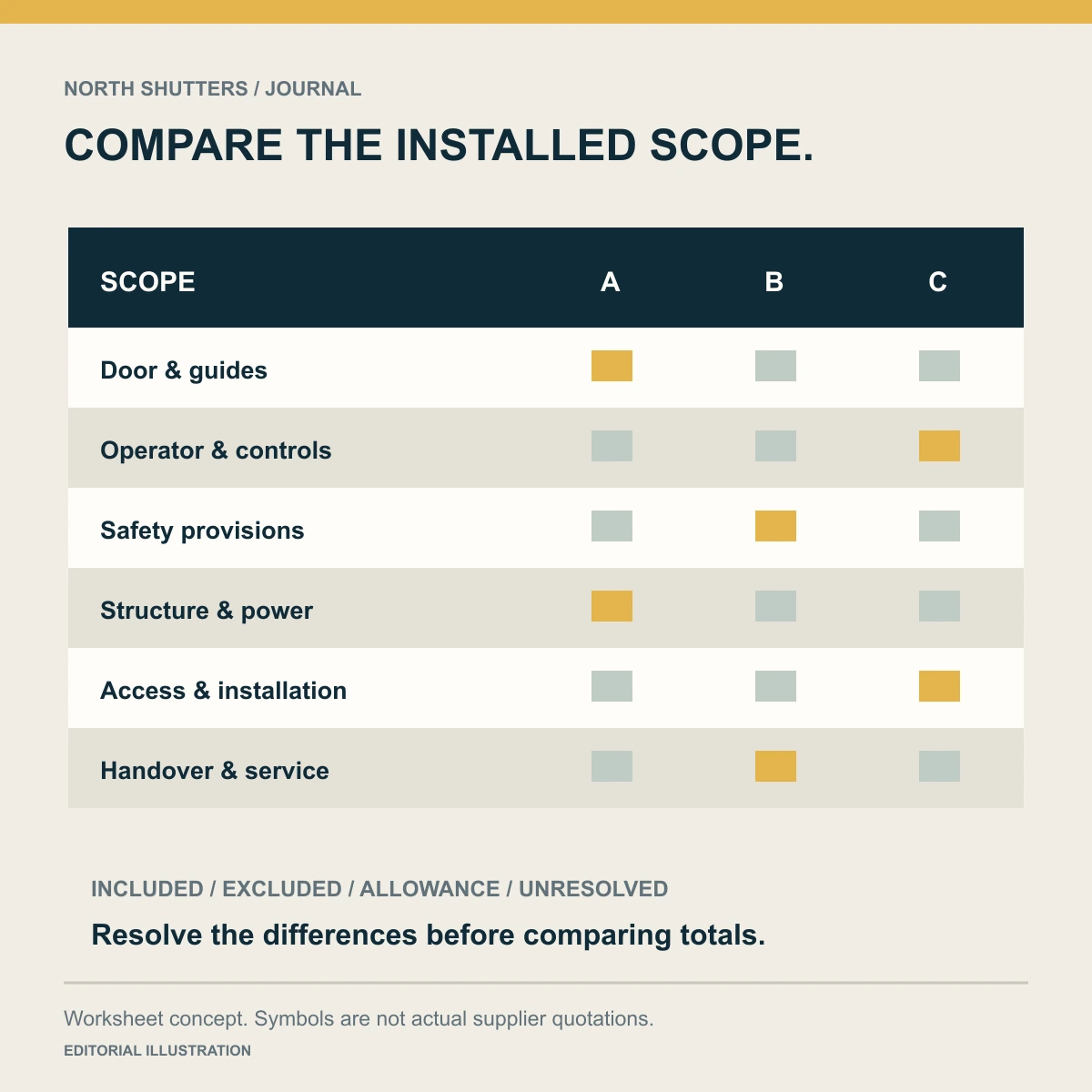
Compare commercial door quotes against one written opening schedule. The useful comparison is the complete installed and commissioned scope: door, operator, mounting, safety provisions, site preparation and handover. A lower headline figure is meaningful only after the exclusions are understood.
Before comparing totals
- Give each supplier the same opening sizes, intended use and site information.
- Identify the door and operator models rather than accepting “heavy duty” as the specification.
- Assign structural, electrical, access and finishing work to named parties.
- Resolve differences in writing before selecting the offer.
1. Issue one common brief
Number the openings and explain what passes through each: people, vehicles, pallet trucks or equipment. State the clear opening you need after installation, the expected pattern of use and any peak periods. Distinguish an occasional storage closure from a busy delivery opening.
Provide photographs, available drawings and known constraints above and beside the opening. Describe the building’s operating hours, installation access and whether business activity must continue during the work. Identify any fire-separation, access-control or building requirements for the project team to resolve; do not assume an ordinary service door satisfies them.
Require every bidder to state its assumptions. An estimate based on the existing opening and a proposal that includes changing the opening should not enter the comparison as though the site conditions were identical.
2. Fill in this matrix for each offer
| Line item | What to record | Clarify if missing |
|---|---|---|
| Opening | Opening ID, clear width and height, mounting location | Do quoted dimensions describe the clear passage or the product? |
| Door assembly | Model, curtain or panels, guides, finish, seals and documentation | Which claims apply to the exact assembly? |
| Operating duty | Intended use, operating pattern and stated duty limits | Does the proposed operator suit peak use? |
| Operator & controls | Model, power supply, controls and access-control interfaces | What works during loss of power? |
| Safety provisions | Specified devices, control mode and commissioning checks | Who confirms the system arrangement is appropriate? |
| Structure & preparation | Support, fixings, opening repairs and removals | Which party designs and supplies each item? |
| Electrical & integration | Power, isolation and interface responsibilities | Included, excluded or supplied by another trade? |
| Installation access | Lifting equipment, work zone, working hours and disposal | Are access equipment and out-of-hours work included? |
| Handover & service | Demonstration, manuals, maintenance and written warranty terms | Who responds to faults, and on what stated terms? |
| Commercial terms | Itemized total, taxes, exclusions, validity and change procedure | What can alter the price or programme? |
When comparing insulation claims, ask what the published value measures and whether the installation detail includes the seals and thermal features you need. When comparing wind or security claims, request the relevant documentation for the specified size and assembly. A descriptive adjective cannot answer those questions.
3. A real project exposes a common quote gap
A published waste-management facility case involved 20 large service doors. The architectural drawings lacked the structural support required for the rolling doors, so the project team had to coordinate a revised support solution with the door supplier and installer.
For quote review, the important issue is the boundary between a door price and a workable opening. A bidder can correctly price the door while the project still lacks necessary supporting work. Ask who verifies the support, who supplies it and what information must be approved before manufacture.
Use that project lesson to assign support verification before ordering. Record who confirms the detail, which drawing revision governs the work and how a change to the opening will be priced.
4. Separate a confirmed allowance from an unresolved exclusion
Mark each line as included, excluded, an allowance or awaiting confirmation. “Electrical by others” should name the responsible trade and describe the handoff. “Installation included” should still explain access equipment, removal and the condition in which the opening must be provided.
If two offers differ in controls, duty or preparation, ask each supplier to price the same baseline. Keep useful alternatives as separate options. This lets you compare the minimum complete scope and then decide whether an upgrade addresses a real operating need.
5. Send this clarification before accepting
For opening ___, please confirm the proposed door and operator models, resulting clear opening and intended operating duty. Please identify the included controls and safety devices; the loss-of-power arrangement; responsibility for structural support, electrical work and access equipment; and the commissioning, user demonstration and maintenance documents included. Please list exclusions, allowances, warranty terms and any conditions that can change the price or delivery programme.
Keep the written reply with the quotation and approved opening schedule. Before installation, check that the site is ready on the agreed basis. At handover, make sure the people who actually use the door receive the operating demonstration and know how to report a fault.
Put the plan into practice
Industrial specification checklist · Storefront planning · Industrial doors · Commercial shutters
Sources & further reading
- Published project: door supply and structural coordination at a waste facility
- Garaga: commercial product comparison and scope assumptions
- Garaga: installation and price factors
Sources reviewed October 30, 2026.