
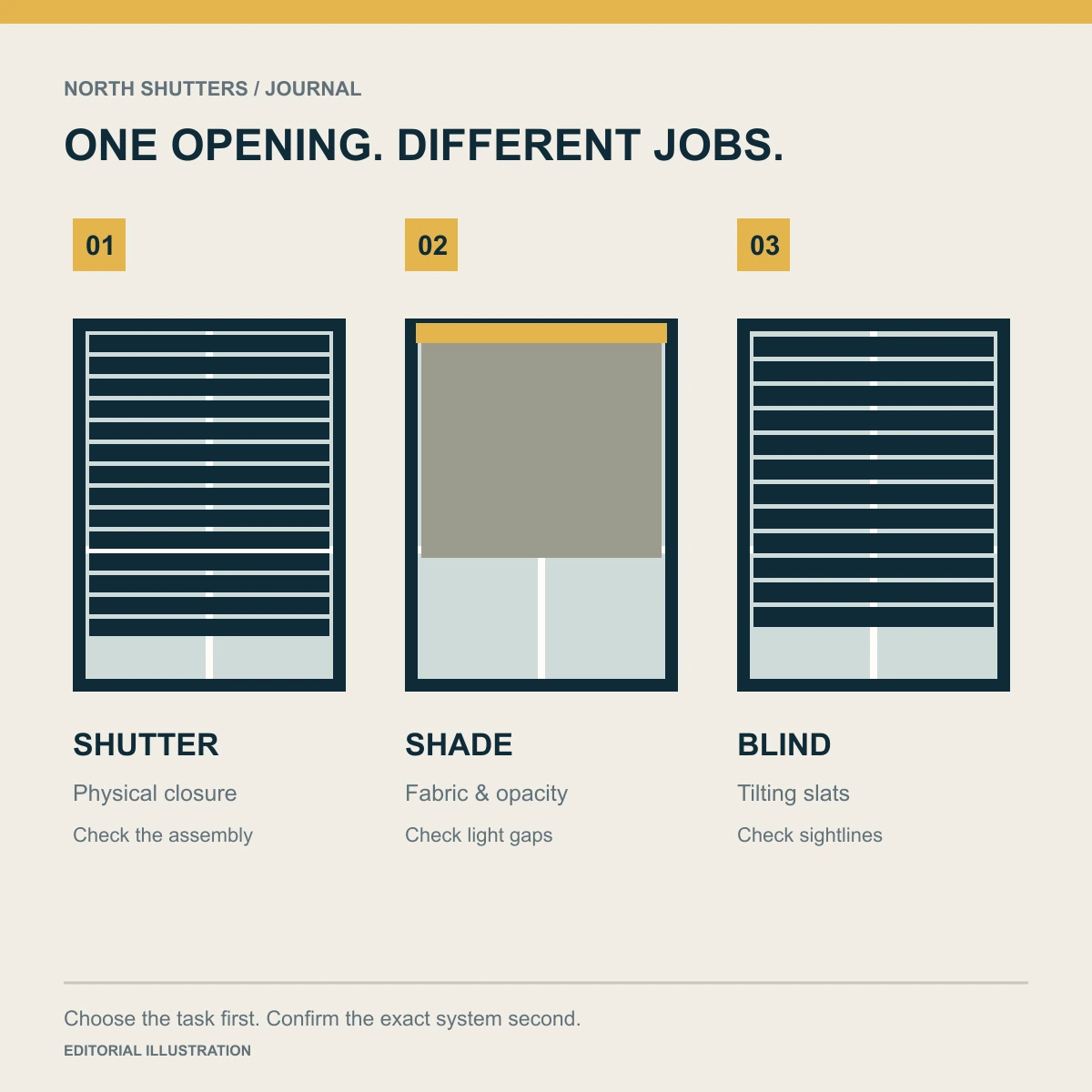
Choose a security shutter when the project needs a physical closure over an opening. Choose shades or blinds when the primary job is to manage light and privacy inside a room. Some properties need both layers, operated for different reasons.
Decide in one minute
- Accessible glass and after-hours protection: assess a shutter system, its guides, mounting and operating plan.
- Glare, daytime comfort or a softer interior: compare shade fabrics and opacity.
- Adjustable daylight while the covering stays down: consider tilting blind slats.
- Children in the home: make accessible-cord safety a separate selection requirement.
1. Write the problem as an observable task
“We need better window coverings” is too broad for a useful comparison. Write a sentence for each opening: “Reduce afternoon glare at the desk,” “Keep the bedroom private after dark,” or “Close off accessible glazing when the shop is shut.” Rank those tasks before discussing finish or automation.
In normal window-covering terminology, blinds use slats or louvres; shades use a fabric or similar covering that raises, lowers or folds. Some fabric shadings also have adjustable vanes, so the product mechanism matters more than the showroom label. A security shutter is a different system: its curtain and guides close across an opening. Neither an interior shade nor an ordinary decorative blind should be treated as a security barrier.
2. Compare the complete systems
| Priority | Security shutter | Shade | Blind |
|---|---|---|---|
| Physical closure | Assess curtain, guides, fixings and documented performance | Not a substitute for a security closure | Not a substitute for a security closure |
| Light control | Check how much light remains with the proposed curtain position | Compare fabric opacity, fit and side gaps | Check slat tilt, overlap and raised stack |
| Night-time privacy | Review curtain coverage and any perforation | Test the chosen fabric with indoor lights on | Check sightlines through tilted slats |
| Space and access | Allow for storage box, guides and service access | Check recess depth, roller or headrail and obstructions | Check slat clearance, headrail and handle interference |
| Outage operation | Confirm the exact drive and any override or backup | Identify manual or stored-energy operation | Identify manual or stored-energy operation |
Do not assume that “blackout fabric” means a completely dark room. The installed arrangement includes side gaps, top details and the mounting position. Likewise, do not treat a shutter’s appearance or material name as evidence of a tested resistance rating. Ask for the relevant documentation for the quoted assembly if that rating is part of the brief.
3. A published project shows why one specification rarely fits every opening
A documented convention-centre project used more than 85 rolling doors and grilles. A coordinated stainless-steel finish was available across several door types, including counter closures and wide registration-desk grilles. The visual requirement was consistent; the functions differed by opening.
The editorial lesson is useful even in a small property: keep the finish coordinated where it matters, but specify the job separately. A transparent shop display, a private back office and a secure stockroom do not become the same opening because they share a colour scheme. The project does not establish a performance rating for another product or installation.
4. Use this room-by-room checklist
- Name the opening and its main job. Identify whether the concern is glare, privacy, a physical barrier or a combination.
- Check at the time the problem occurs. Assess glare during the relevant sun exposure and privacy after dark with the room lit.
- Show how the window or door moves. Include handles, inward-opening sashes and the route people use through patio doors.
- List who will operate it. Reach, strength, visibility and accessible cords all affect the choice.
- Ask to see the open position. The stored curtain, fabric roll or slat stack should work with the view and daily access.
- Confirm the separate requirements. Record emergency access, mounting, maintenance and any property approvals.
For a Toronto street-facing room, test privacy from the actual pavement sightline rather than judging a sample against a showroom wall. For a rear patio door, first keep a practical passage routine. Those checks explain more than a general promise that one product is “best.”
Put the plan into practice
Light and privacy planning · Child-safety checklist · Security shutters · Interior shading
Sources & further reading
- Hunter Douglas: differences between blinds and shades
- Hunter Douglas: inside and outside mounting
- Published project: coordinated doors and grilles in a convention centre
Sources reviewed October 30, 2026.