
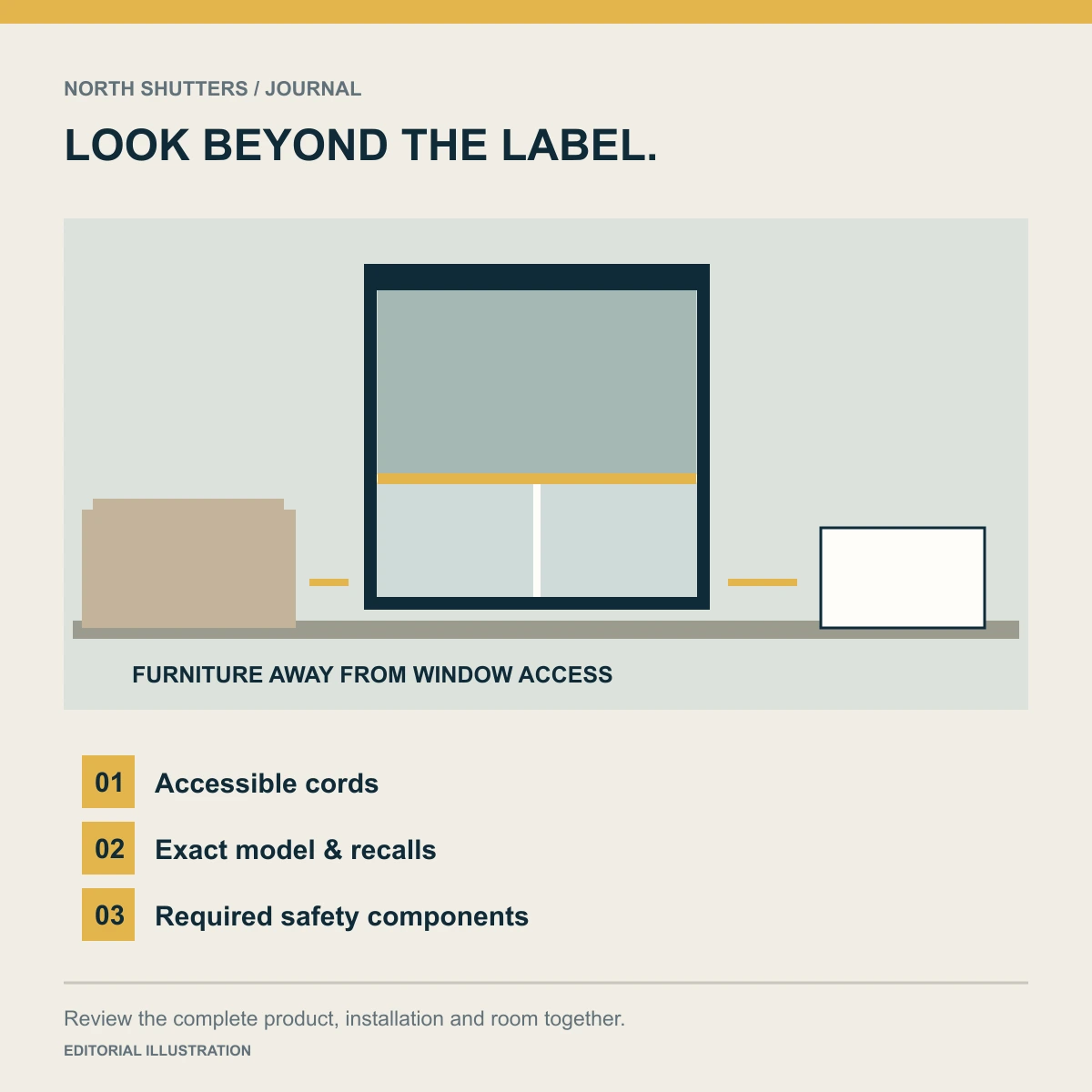
For a home where children live or visit, begin by choosing coverings without long accessible cords. Then check the exact product model, recall information, installation accessories and the room around the window. Motorization or a cordless label does not replace those checks.
The first four checks
- Inspect the front, back and sides for accessible operating or inner cords.
- Keep climbable furniture, beds, cribs and play spaces away from window-cord access.
- Check the exact model against Canadian recall notices.
- Keep all required safety components installed and follow the product instructions.
Start with the hazard you can remove
Health Canada advises replacing coverings with long accessible cords, prioritizing children’s rooms and play spaces if replacement must be phased. Its guidance includes inner cords as well as visible operating cords. Children can reach a cord by climbing, and supervision alone is not a reliable control.
Walk through the home from a child’s likely routes: a sofa beneath a window, a toy box beside a sill, or a bed moved against the wall. Include rooms used by visiting children. Do the inspection with the covering in different positions because the accessible parts can change as it is raised or lowered.
If an older corded covering cannot immediately be replaced, follow Health Canada’s interim precautions and the manufacturer’s warnings. Keep cords inaccessible and secure supplied tension devices as instructed. Treat this as risk reduction while arranging replacement, rather than a reason to stop reviewing the room.
A real recall shows why the model matters
A Canadian recall updated in February 2024 covered specific mini-blinds sold as cordless. Health Canada identified strangulation and small-part choking hazards and instructed consumers to stop using the affected products and contact the seller for a refund. The notice listed particular sizes and UPCs.
The lesson is precise: shop by the complete product identity, not by the word “cordless” alone. It does not mean every cordless blind shares the defect. Keep the model, size, supplier and receipt so you can match a future notice to what is actually installed.
Before buying: ask these questions
- What is the exact product and operating system? Record the model rather than only the collection name or fabric colour.
- What can a child reach? Ask to see operating and inner-cord access with the covering fully raised, lowered and partly open.
- What safety components are required? Identify guards, shields, tension devices and other supplied accessories and how they remain secured.
- What information demonstrates suitability for sale in Canada? Ask the supplier for the relevant product documentation and installation instructions.
- Are there recall notices for this exact model? Compare the product identifier and affected range, not just the photograph.
- Can adults operate it comfortably? Test reach and normal operation without introducing a stool or other climbable object near the window.
- Who confirms the finished installation? Make the safety components and user demonstration part of the handover.
For a motorized covering, ask how controls are stored, whether batteries are user-accessible and what the manufacturer says about replacement. Keep small loose components and remote controls out of children’s reach. Use the supplied instructions for the specific device rather than assuming every remote has the same battery arrangement.
Exterior shutters add a different planning question
An exterior shutter can change access through an opening and introduces a moving curtain. Ask how people will pass through a protected door, how emergency access is addressed and what happens if electrical power is unavailable. Keep children clear during movement and do not invite them to test obstacle response.
Do not infer safety features from “automatic” or “smart.” Get the actual operating and safety information for the selected assembly. A shutter, insect screen and interior shade can all be present at one opening, so inspect the combined arrangement rather than checking each brochure separately.
After installation: keep the check alive
- Retain the model details, manuals, receipt and installation record together.
- Confirm all required accessories are fitted; do not remove a guard for appearance or convenience.
- Look for damaged parts, newly accessible cords or loose attachments during normal room care.
- Reassess after furniture is moved, a room becomes a nursery or a child starts climbing.
- If the product matches a recall, follow that notice’s stop-use and remedy instructions.
A practical buying brief can be one sentence: “This room is used by young children; show the complete operating system and safety components, and confirm the exact model.” It gives the supplier something concrete to answer before a colour choice takes over the discussion.
Put the plan into practice
Compare covering types · Plan for an outage · Interior shading options
Sources & further reading
- Health Canada: window covering safety
- Canadian recall: specific cordless mini-blind models, February 2024
- Health Canada product recalls and safety alerts
Sources reviewed October 30, 2026.